October 2020 is the 75th Annual National Disability Employment Awareness Month

National Disability Employment Awareness Month (NDEAM) is an annual awareness campaign that takes place each October. NDEAM provides an opportunity to celebrate the contributions made by workers with disabilities.

NDEAM dates back to 1945, when Congress enacted a law declaring the first week in October each year “National Employ the Physically Handicapped Week.” In 1962, the word “physically” was removed to acknowledge the employment needs and contributions of individuals with all types of disabilities. In 1988, Congress expanded the week to a month and changed the name to National Disability Employment Awareness Month.
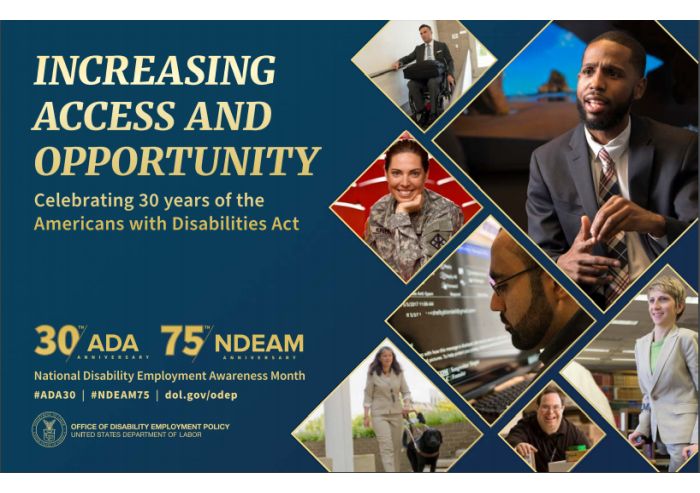
NDEAM Poster

This year’s special celebration is not only the 75th anniversary of NDEAM, but also the 30th anniversary of the Americans with Disabilities Act (ADA). The ADA is landmark legislation that reaffirms our nation’s founding ideal of equality for all by increasing access and opportunity for people with disabilities across all aspects of community life, including employment.

Learn more about how you can participate in National Disability Employment Awareness Month and ways you can promote its messages to others during October, and throughout the year. Simply visit the U.S. Department of Labor NDEAM website to learn more and show your support.

The ADA is turning 30!

ADA 30 Years 1990-220July 26, 2020 is the 30th Anniversary of the Americans with Disabilities Act (ADA), signed into law by President George Herbert Walker Bush on July 26, 1990. The ADA (42 U.S.C. § 12101)  protects people in the United States from discrimination based on disability.

California Governor Gavin Newsom acknowledged the ADA anniversary by proclaiming July 26 Americans with Disabilities Act Awareness Day.

The U.S. Department of Labor’s ADA 30 page has tips on Events and Activities, and How You can Celebrate.

November 14 is World Usability Day

World Usability Day logoWorld Usability Day (WUD) , also known as Make Things Easier Day, is held annually on the second Thursday of November.

WUD is the annual global event for exploring and promoting how responsible technology design improves the human condition. From the World Usability Day Charter:

Technology should enhance our lives, not add to our stress or cause danger through poor design or poor quality. It is our duty to ensure that this technology is effective, efficient, satisfying and reliable, and that it is usable by all people. This is particularly important for people with disabilities, because technology can enhance their lives, letting them fully participate in work, social and civic experiences.

WUD’s theme for 2019 is Designing for the Future We Want.

Deadline Fast Approaching for California Web Accessibility

July 1, 2019 is the deadline for all California state agencies to publicly certify their websites as compliant with WCAG 2.0 Level AA and Section 508.

Deadline Fast Approaching for California Web AccessibilityThen-Governor Jerry Brown signed Assembly Bill 434 into law in October, 2017, creating Government Code section 11546.7. Agencies were given until the start of California state fiscal year 2019/2020 to comply. The law strengthens previous accessibility laws and regulations, for which compliance and enforcement were inconsistent.

California’s Department of Rehabilitation (DOR) developed a AB 434 Website Accessibility Toolkit to assist other agencies in complying with the new law. DOR also offers website and document accessibility training to state employees.

Going forward, state agencies will be required to re-certify their website’s accessibility every two years.

California celebrates the ADA 28th anniversay

California will host a free event celebrating the anniversary of the Americans with Disabilities Act (ADA). Signed into law in 1990, the ADA has been a driving force of disability equality, inclusion, and accessibility for 28 years.

Americans with Disabilities Act (ADA) 1990-2018

The day of learning, activities, and entertainment will take place at the State Capital, and is intended to generate public awareness and provide insight into the progress and continuing path forward for disability inclusion in California. For details visit the ADA Anniversary website.

W3C issues WCAG 2.1

WC3 logo | W3C issues WCAG 2.1The World Wide Web Consortium (W3C) yesterday issued Web Content Accessibility Guidelines (WCAG) 2.1 as a Recommendation.  WCAG 2.1 includes all the guidelines from WCAG 2.0, and adds 17 new criteria. Many of the new guidelines deal with accessibility on mobile devices, a topic which is not specifically addressed in WCAG 2.0. WCAG 2.1 also includes new guidelines addressing cognitive and learning disabilities, and low vision.

The W3C stated in their press release on the topic:

“WCAG 2.1 updates WCAG 2.0 and expands W3C’s accessibility guidance, while maintaining W3C’s standard of implementable, technology neutral, objectively testable and universally applicable accessibility guidance. All new provisions have been tested in implementations across different types of websites and web content. The Working Group has taken care to maintain backwards compatibility with the internationally-recognized WCAG 2.0, in that websites that conform to WCAG 2.1 will also conform to WCAG 2.0, which remains a W3C Recommendation.”

PAC 3 released by Access for All

Access for All released PAC 3, the latest version of the free PDF Accessibility Checker, in December 2017. Access for All reports the following improvements:

  • Overview report can be exported as a barrier-free PDF.
  • Optimized accessibility of the user interface.
  • PAC is now available in English and German. More specifically, the language automatically depends on the language set in the operating system of your computer. If this is neither German nor English, PAC will be executed in the English version.
  • New “Artifacts” tab in the Logical Structure dialog box for quick viewing and review of all decorative items.
  • Additional attributes on the Properties tab in the Logical Structure dialog such as PrintField attributes, IsMap attribute, and ListNumbering attribute.
  • Another checkpoint in the category Logical structure”> “Structure elements”> Tables: Assignment of header cells”.
PAC 3 Screen Shot (click for full size image)

After using PAC 3 in parallel with PAC 2 for a few weeks, as far as I have been able to tell the test functionality is identical – with the exception of the new check for assignment of header cells. PAC 3 has an improved user interface, in my opinion, and unlike PAC 2 is itself fully accessible to assistive technology users.

The ability to produce a summary test report in accessible PDF format is a very welcome new feature. The Screen Reader Preview seems slightly improved, with images displayed smaller than in PAC 2. PAC 3 also seems more stable than PAC 2 – I tested a couple of files that crashed PAC 2 but not PAC 3. I have only detected one minor glitch in PAC 3 – the metrics (e.g. number of failed Content checkpoints) in the summary report are exactly double those in PAC 2 and in the PAC 3 detailed report.

In conclusion, PAC 3 is a welcome addition to my PDF accessibility toolbox. PAC 3 – and also the older PAC 1.3 and PAC 2 – can be downloaded from Access for All (http://www.access-for-all.ch/en/pdf-lab/pdf-accessibility-checker-pac.html).

PDF Day | Washington DC | January 29 2018

PDF Day logoJanuary 29 2018 is PDF Day, held at the US National Archives building in Washington DC.

“This PDF Association event brings industry experts, vendors and managers together to discuss the importance and utility of the Portable Document Format, its various ISO standards, and the wide-ranging technologies available to government workflows.”

“PDF Day is hosted by the National Archives and Records Administration’s (NARA), which has generously donated space for the PDF Day at the National Archives Building on Pennsylvania Avenue, in the heart of the nation’s capital.”

“It’s a do-not-miss event for government and business professionals, managers and executives dealing with document management technology and policy.”

www.pdfa.org/event/pdf-day-washington-dc/

GAAD 2017: May 18 is the Global Accessibility Awareness Day

GAAD logoMay 18 is GAAD 2017. Global Accessibility Awareness Day, the third Thursday each May, is targeted toward all of us who design, develop, build, fund, and influence technology. The purpose of GAAD is to get everyone talking, thinking and learning about digital access/inclusion and people with different abilities.

An excellent way to participate in GAAD is to improve the accessibility of your electronic documents. For example:

  • Use the Microsoft Word Accessibility checker early and often every time you develop a Word document.
  • Download the free PDF Accessibility Checker (PAC) from Access for All. PAC is much more thorough than the checker built into Acrobat Pro. PAC also includes a Screenreader Preview feature to help with manual accessibility checks.
  • Use the excellent free Colour Contrast Analyser from the Paciello Group to check for proper color contrast of the text in your documents.